An Olympic sport that combines speed, intelligence and respect. Here is a short guide to how it works, what it is good for and how to get started.
Two fencers face each other on a strip 14 metres long and 1.5 to 2 metres wide (the piste), each trying to hit the other first with the point or edge of the blade. Every hit is registered electronically and lights up: red for one fencer, green for the other.
Pool bouts are fought to 5 touches and direct-elimination bouts to 15. Speed and stamina matter, but bouts are usually won in the head, which is why fencing is called “physical chess”.
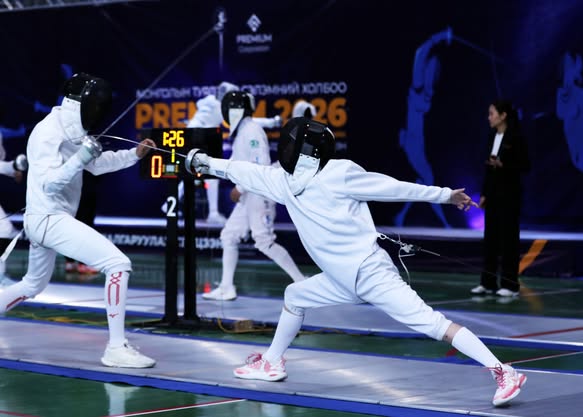
Each weapon has its own weight, target area and rules. Épée is the most widely fenced weapon in Mongolia. At the 2026 Asian Games our fencers competed in all three for the first time.
Fencers make several decisions a second. Children’s concentration and reaction times improve.
Every bout starts with a salute and ends with a handshake. Fencing teaches respect for the rules, the referee and the opponent.
Leg strength, balance, flexibility and coordination. It develops children’s bodies evenly.
Fencers wear special clothing, a mask and a glove and follow strict rules, so the risk of injury is low.
From age 6 into old age. Internationally there are veterans’ events even for fencers over 70.
The path is open to Asian and world championships and Olympic qualification. Fencing can also help with scholarships and university admission.
From martial art to Olympic sport.
Swordsmanship began to be taught in fencing schools in Europe, and the light practice weapon, the foil, was born. The schools’ rules and customs became the basis of the modern sport.
Fencing was part of the Athens Olympics and is one of the few sports that has featured at every Olympic Games since.
The International Fencing Federation (FIE) was founded in Paris and one set of rules was agreed for the whole world.
Hits have been registered electrically in épée since 1936, in foil since 1956 and in sabre since 1988, making refereeing fairer and bouts faster.
Mongolia’s steppe cavalry was famous for the curved sabre. As a modern sport, Mongolian fencing has grown quickly since 2009.
On 17 March 1949 the newspaper “Zaluuchuudyn Unen” reported a swordsmanship event at a military sports competition held for the 28th anniversary of the state.
Source: news.mn, 2015
The Fencing Association of Mongolia was founded. The same year B. Battumur became the first Mongolian to compete at a World Championships.
The first men’s national championships took place. Women’s events followed in 2013 and team events in 2014.
Ulaanbaatar hosted the Asian U23, cadet and junior championships and the Asian Fencing Confederation’s general assembly, with more than 250 fencers from 35 countries.
International Master of Sport B. Amarzayaa won bronze at the Asia-Oceania Olympic qualifying tournament for the second time. The federation celebrated its 15th anniversary.
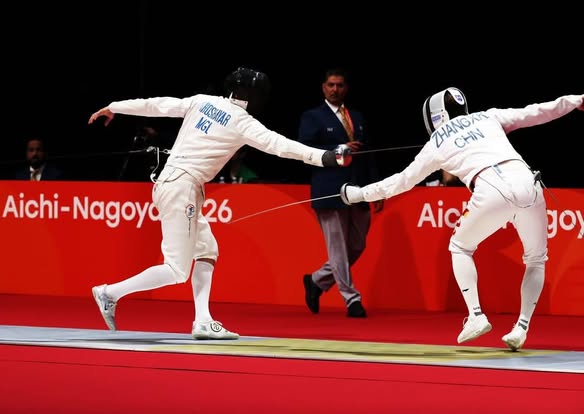
At the Asian Games in Aichi-Nagoya, Mongolia’s national team competed in all three weapons for the first time, and U. Munkhkhasar set a national record by winning 4 of 6 pool bouts. Ulaanbaatar hosted the IUFC international club league for the first time, with more than 180 fencers from 7 countries.
Every bout begins and ends with the same ritual.
Before the bout, fencers take off their masks and salute their opponent, the referee and the audience with the blade.
The referee starts the bout in French and stops it after each hit with “Halte!”.
Win or lose, fencers shake hands with their opponent after the bout and thank the referee.
Most clubs take children from age 6, and there are classes for adults too. Federation tournaments start at the U8 category.
For the first lessons clubs lend masks, jackets and weapons. Once you start competing you will need your own kit; your coach will advise you.
Fencers wear protective clothing (350N from U14, 800N from cadets up), a mask and a glove, so fencing counts among the sports with few injuries.
Train at a club, get your federation licence and enter a tournament for your age category online in the Tournaments section of this site.
Most children start with foil or épée. Your coach will suggest the weapon that suits you best.
Find a club near you and sign up for a trial lesson.